


Supply Chain Management
ZOZO Group aims to conduct its business with full consideration for the impact on the environment and society through co-creation and collaboration with brands that have stores on ZOZOTOWN and suppliers that form the supply chain. To achieve this, procurement policies are established and communicated for suppliers, and regular surveys and dialogues are conducted with them. Through these efforts, we strive to realize our sustainability statement, "Fashion Connects and Leads us to a Sustainable Future."
Basic Environmental Policy
Basic Human Rights Policy
ZOZO Sustainability Procurement Policy
ZOZO Group has formulated ZOZO Sustainability Procurement Policy for all of its business partners and suppliers in order to realize its Sustainability Statement, "Fashion Connects and Leads us to a Sustainable Future." This policy is based on the OECD Guidelines for Multinational Enterprises, the United Nations Global Compact (UNGC), and UN Guiding Principles on Business and Human Rights, while also considering our materialities and formulating it based on the Japanese laws and regulations where our head office is located.
1. Compliance with Laws and Ordinances
We comply with all laws and ordinances applicable to the jurisdictions in which the company operates. We also ensure conduct in accordance with international and industry norms.
2. Human Rights
We respect internationally recognized human rights throughout the supply chain. In particular, based on the ILO Declaration on Fundamental Principles and Rights at Work, we respect the freedom of association, prohibit child labor and forced labor, and aim to eliminate all discrimination and harassment in employment and the workplace. In addition, when we identify that it has caused or contributed to an adverse impact on human rights, we will remedy the adversely affected person through appropriate and proper procedures.
3. Labor practices
We protect the rights of workers by paying appropriate wages and benefits, providing welfare benefits, and entering into labor contracts in accordance with international norms and the laws and regulations of the jurisdictions in which we conduct business. In accordance with international norms and laws and regulations in the jurisdictions in which we conduct business, we give consideration to the work environment, health, and safety of all employees involved in our business, including the elimination of excessive labor. We respect diverse individuality and values, and realize a fair and inclusive work environment and business partner relationships.
4. Human Capital and Human Resource Development
We actively support the formation and improvement of human capital in order to enhance the employability of our employees into the future.
5. Environment
Wel give consideration to climate change, ecosystems and natural capital, and environmental sustainability, including hazardous chemical substances, throughout our business, based on international norms and laws and regulations in the jurisdictions in which we conduct business.
6. Anti-Corruption
We do not offer, promise, give or demand bribes or other unjust benefits, directly or indirectly, for the purpose of acquiring or maintaining commercial transactions or other unjust benefits.
7. Information Security
We strictly manage and protect personal information of our company, customers and third parties. We establish a system for strictly managing and protecting information acquired in business, and do not leak it to third parties without permission. We develop and implement measures to prevent computer viruses, other network risks, threats and to prevent their impact from expanding.
8. Safety and Security
We take all reasonable actions to ensure the quality and reliability of the products and services we provide. We will act in accordance with fair business, sales and advertising practices in our relationships with consumers.
9. Business Continuity Plan
We build a system that prevents major social impacts by continuing our business operations even in the event of natural disasters or other emergencies or major changes in the social environment.
10. Fair trade
We comply with fair trade laws, such as the competition law and the subcontracting law, in accordance with international norms and the laws of the jurisdictions in which we conduct business. We do not engage in any transaction that infringes the intellectual property rights or other rights of any third party. We have no relationship with antisocial forces, and we reject any unreasonable demands.
- ZOZO Sustainability Procurement Policy is approved by the Board of Directors on April 21, 2023
- Revisions and eliminations of this policy will be made by our Board of Directors
- The following are covered
Environment: greenhouse gas emissions, energy consumption, water resource conservation, biodiversity conservation, land conservation, prevention of deforestation, prevention of pollution, waste reduction, resource recycling
Anti-Corruption: conflict of interest
Supply Chain Due Diligence
Aligned with the United Nations Guiding Principles on Business and Human Rights and the OECD Guidelines for Multinational Enterprises, our group has established a comprehensive supply chain due diligence process. We have conducted risk assessment across our supply chain to identify, prevent, and reduce sustainability-related risks.
Process
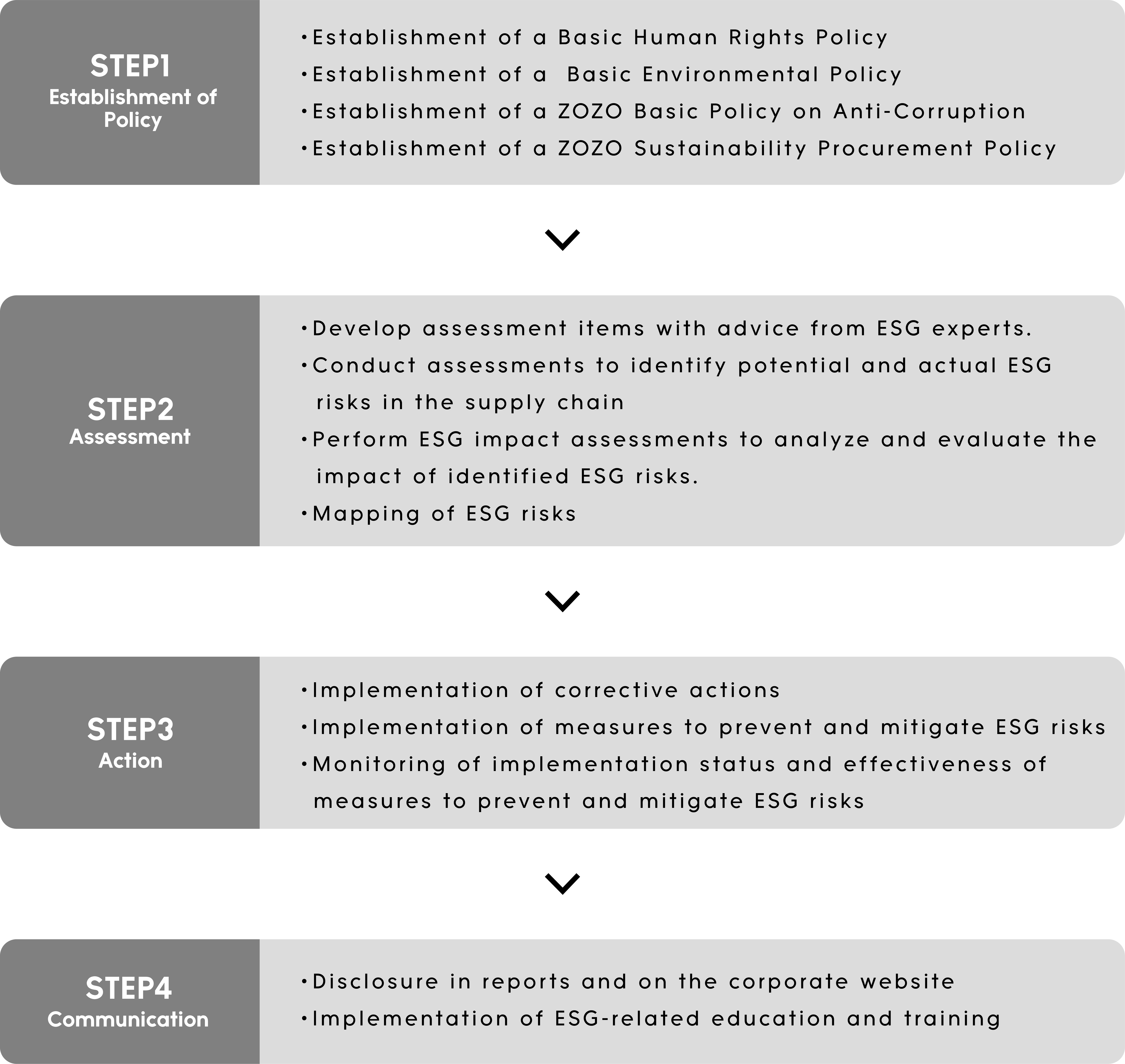
Identifying and Assessing Sustainability Risks
As part of our supply chain due diligence, we selected target companies based on transaction value and business segment, and conducted a questionnaire to identify sustainability-related risks (negative impacts of business activities) within our supply chain.
Summary of the Questionnaire
|
Purpose |
To understand the sustainability practice among our business partners and use the results to reduce supply chain risks and support their efforts. |
||||||||
|
Questions |
34 questions (Environment: 8 / Social: 17 / Governance: 9) |
||||||||
|
Target companies |
42 major business partners
Companies operating stores on ZOZOTOWN: 30 companies surveyed / 27 responses (90.0% response rate)
Other companies: 12 companies surveyed / 11 responses (91.7% response rate) |
||||||||
|
Survey period |
March - May 2026 |
||||||||
Survey Items
|
Category |
Subcategory |
Question Item |
|||||||
|
Environment |
Environment |
Basic approach to environmental management |
|||||||
|
Mechanisms for assessment, identification, and remediation |
|||||||||
|
Engagement with Business Partners |
|||||||||
|
Climate Change |
Scope of greenhouse gas emissions measurement |
||||||||
|
Greenhouse gas emissions reduction targets |
|||||||||
| Social |
Human rights |
Basic approach to human rights |
|||||||
|
Mechanisms for assessment, identification, and remediation |
|||||||||
|
Engagement with Business Partners and Compliance Requirements |
|||||||||
|
Forced labor, human trafficking, and child labor |
|||||||||
|
Production sites |
|||||||||
|
Technical Intern Training Program and Specified Skilled Worker Program |
|||||||||
|
Governance |
Business Ethics |
Approach to anti-corruption |
|||||||
|
Whistleblowing |
Whistleblowing hotline |
||||||||
|
Eligible Users |
|||||||||
|
Supply Chain Management |
Policy or Guideline for supplier |
||||||||
|
Information Security |
Approach to information security |
||||||||
|
Implementation of third-party audits |
|||||||||
Questionnaire Results
The survey found that, while the overall level of sustainability awareness was high, further establishment of policies and management systems, as well as practices for collecting and managing data such as greenhouse gas emissions, were identified as key priorities for each company.
No significant human rights incidents or compliance violations were identified through this survey. However, potential sustainability-related risks were identified at some suppliers. We will work collaboratively with them to prevent risks and promote improvement through targeted engagement, including providing information on international developments and sharing emissions calculation tools. We also plan to gradually expand the scope of target companies to further enhance the effectiveness of this survey.
|
Category |
Assessment Items |
Status |
Future Actions |
|
Environment |
Understanding of environmental laws, regulations, and social norms |
◎ |
|
|
Clear responsibilities and management structure for environmental issues |
◯ |
||
|
Existence of environmental policies and guidelines |
◯ |
||
|
Existence of greenhouse gas emissions reduction targets |
△ |
||
|
Measurement of greenhouse gas (GHG) emissions |
△ |
||
|
Social |
Understanding of the UN Guiding Principles on Business and Human Rights |
◎ |
|
|
Identification of forced labor and other human rights issues within group companies and suppliers |
◯ |
||
|
Mechanisms for assessing, identifying, and remediating human rights risks |
◯ |
||
|
Response to incidents related to forced labor, human trafficking, and child labor |
◯ |
||
|
Identification of supply chain sites located in areas of particular concern |
△ |
||
|
Technical Intern Training Program and Specified Skilled Worker Program at suppliers and contractors |
△ |
||
|
Governance |
Establishment of internal and external whistleblowing hotlines |
◎ |
|
|
Clear responsibilities and management structure for anti-corruption |
◯ |
||
|
Implementation of third-party information security audits |
◯ |
||
|
Eligible Users of the Whistleblowing Hotline |
△ |
◎: 90% or above – Sufficiently addressed
〇: 70% to less than 90% – Generally addressed, with some areas for improvement
△: Below 70% – Improvement is needed and additional support is required